Workplace safety doesn’t start with policy manuals or annual training—it starts with conversation. And few tools spark meaningful dialogue like a well-run toolbox talk. Yet too many teams treat them as routine time-fillers, cycling through the same three topics and checking a compliance box. That’s a missed opportunity. A dynamic, relevant toolbox talk topics list transforms safety from passive awareness into active participation.
This guide delivers a robust set of actionable, real-world-focused topics that reflect actual job site risks. Whether you’re managing a construction crew, supervising maintenance teams, or leading industrial operations, this list helps you stay ahead of hazards—before they become incidents.
Why a Strong Toolbox Talk Topics List Matters
Toolbox talks are short, informal safety meetings—usually 10 to 15 minutes—held at the job site before work begins. Their power lies in timing and relevance. When delivered right after shift kick-off, they align safety messaging with the day’s tasks. But their effectiveness hinges entirely on topic quality.
A stale or generic topics list leads to disengagement. Workers zone out. Supervisors rush through slides. The moment for impact is lost.
A strategic list, however, does three things: - Targets current risks – such as working at height during roofing, not generic fall protection. - Encourages interaction – by asking questions like, “What would you do if a ladder shifted under you?” - Documents engagement – creating a paper trail that shows proactive safety culture.
Without a diverse, evolving topics list, your toolbox talks become performative rather than preventative.
Core Categories for Your Topics List
To build a resilient safety rhythm, spread your toolbox talks across key hazard zones. Rotate through these categories monthly to ensure full coverage:
#### 1. Physical Hazards Falls, slips, struck-by incidents, and caught-in/between scenarios dominate OSHA records. Topics here must be hyper-localized.
Examples: - Ladder safety during HVAC installation - Proper use of fall protection on elevated platforms - Securing materials on scaffolds to prevent drop hazards
Common mistake: Using generic fall protection talk points when working near skylights requires specific controls like guardrails or covers.
#### 2. PPE and Personal Readiness It’s not just about wearing gear—it’s about wearing it correctly, inspecting it, and understanding its limits.
Examples: - When to replace damaged gloves or hard hats - Proper fit of respirators in dusty environments - High-visibility clothing requirements during low-light shifts
Workflow tip: Bring in a worn hard hat or torn harness during the talk. Let workers inspect it—hands-on beats theory.
#### 3. Equipment and Tools Misuse of power tools, unguarded machinery, or improper lockout/tagout procedures cause serious injuries.
Examples: - Pre-use inspection checklist for grinders - Safe handling of compressed gas cylinders - Why bypassing machine guards is never acceptable
Realistic case: A maintenance worker ignored lockout procedures, assuming “it won’t take long.” Machine unexpectedly cycled. Result: severe hand injury. Use this to stress urgency.
#### 4. Environmental and Site Conditions Weather, terrain, and site layout create dynamic hazards.
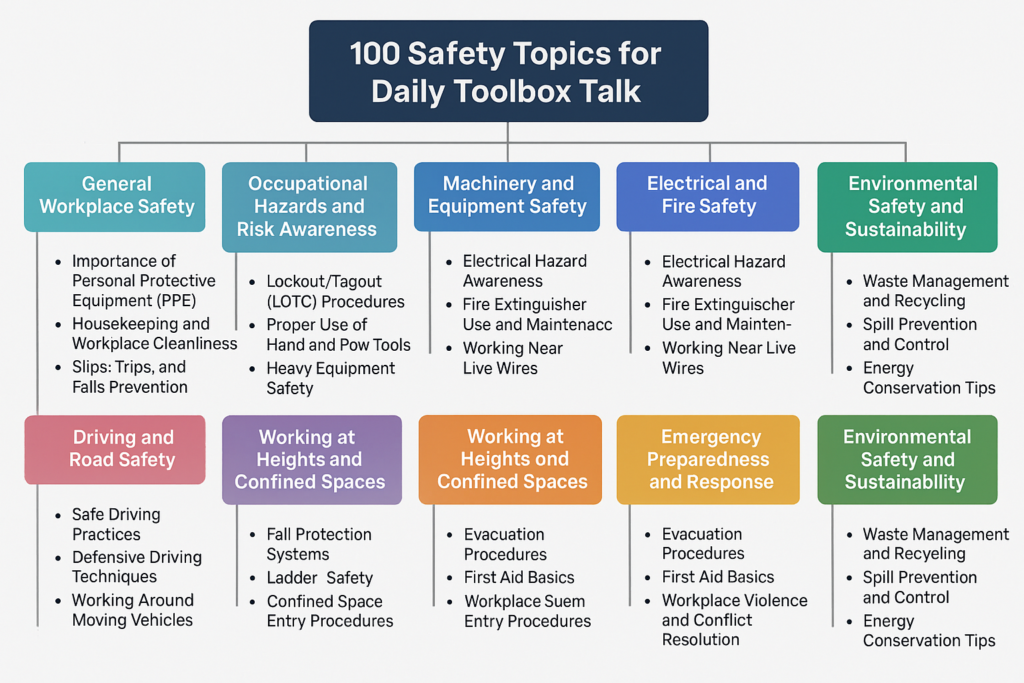
Examples: - Working safely in extreme heat or cold - Identifying overhead power lines before excavation - Housekeeping to prevent tripping in congested areas
Pro insight: Schedule more frequent talks during seasonal transitions—heat stress talks in early summer, ice awareness in winter thaw periods.
#### 5. Behavioral and Cultural Factors Safety isn’t just physical—it’s psychological. Peer pressure, fatigue, and complacency erode judgment.
Examples: - Speaking up when someone skips a safety step - Recognizing fatigue signs in yourself and coworkers - The danger of rushing during close-of-day
Practical approach: Use role-play. Ask, “If your buddy refuses to wear fall protection, how do you respond?” Let the team discuss options.
25 High-Impact Toolbox Talk Topics (Ready-to-Use List)
This curated list spans high-risk areas and common oversights. Rotate through them monthly, adjusting for project phase and site conditions.
- Safe Use of Ladders on Uneven Ground
- Focus: Extension ladder setup, 4:1 ratio, securing top and bottom.
- Fall Protection for Roof Work
- Detail: Harness inspection, anchor points, rescue planning.
- Hand Tool Safety: Beyond the Basics
- Include: Inspecting for cracks, proper storage, using the right tool for the job.
- Eye Protection in Grinding Operations
- Stress: Face shields vs. safety glasses, debris direction, PPE compatibility.
- Hazard Communication (HazCom) and SDS Review
- Drill: Where to find SDS sheets, understanding GHS pictograms.
- Noise Exposure and Hearing Protection
- Discuss: When noise exceeds 85 dB, proper earplug insertion.
- Working Around Heavy Equipment
- Emphasize: Blind spots, signaling protocols, wearing high-vis.
- Slips, Trips, and Falls on Level Surfaces
- Often ignored: Wet floors, loose cables, cluttered walkways.
- Hot Work Permits and Fire Prevention
- Include: Required clearance, fire watch duties, extinguisher availability.
- Electrical Safety Near Overhead Lines
- Critical: Minimum approach distances, equipment lowering procedures.
- Trenching and Excavation Hazards
- Cover: Soil types, shoring requirements, egress ladders.
- Proper Lifting Techniques
- Demo: Squat-lift motion, avoiding twisting, team lifts for heavy loads.
- Confined Space Entry Awareness
- Note: Even brief entries require permits, gas testing, and attendants.
- Scaffold Safety: Inspection and Use
- Highlight: Planking gaps, guardrails, load limits.
- Machine Guarding and Maintenance
- Reinforce: Never operate unguarded equipment, reporting damaged guards.
- Cold Stress and Winter Work Risks
- Educate: Symptoms of hypothermia, layering strategies, buddy system.
- Heat Stress Prevention
- Monitor: Hydration, rest breaks, acclimatization for new workers.
- Safe Operation of Forklifts and Powered Industrial Trucks
- Remind: Seatbelts, load capacity, pedestrian right-of-way.
- Welding Safety and Fume Extraction
- Include: Ventilation needs, fire watch, UV exposure protection.
- Lockout/Tagout (LOTO) Procedures
- Drill: Isolation steps, group lockout, verifying zero energy.
- Housekeeping for Injury Prevention
- Clarify: “Clean as you go” isn’t optional—it’s a control measure.
- Personal Responsibility in Safety
- Challenge: “It’s not just the supervisor’s job to keep us safe.”
- Near-Miss Reporting Culture
- Promote: No-blame reporting, how to document, why it matters.
- PPE Inspection and Care
- Hands-on: Show examples of damaged gear—when to tag out.
- Emergency Response: Site-Specific Plans
- Confirm: Evacuation routes, muster points, first aid kit locations.
How to Use
This List Effectively
Having a list is step one. Execution determines impact.
Rotate by Risk Level High-risk tasks (e.g., working at height, excavation) deserve more frequent talks—quarterly or even monthly. Low-frequency but high-consequence topics (confined space, LOTO) should appear at least twice a year.
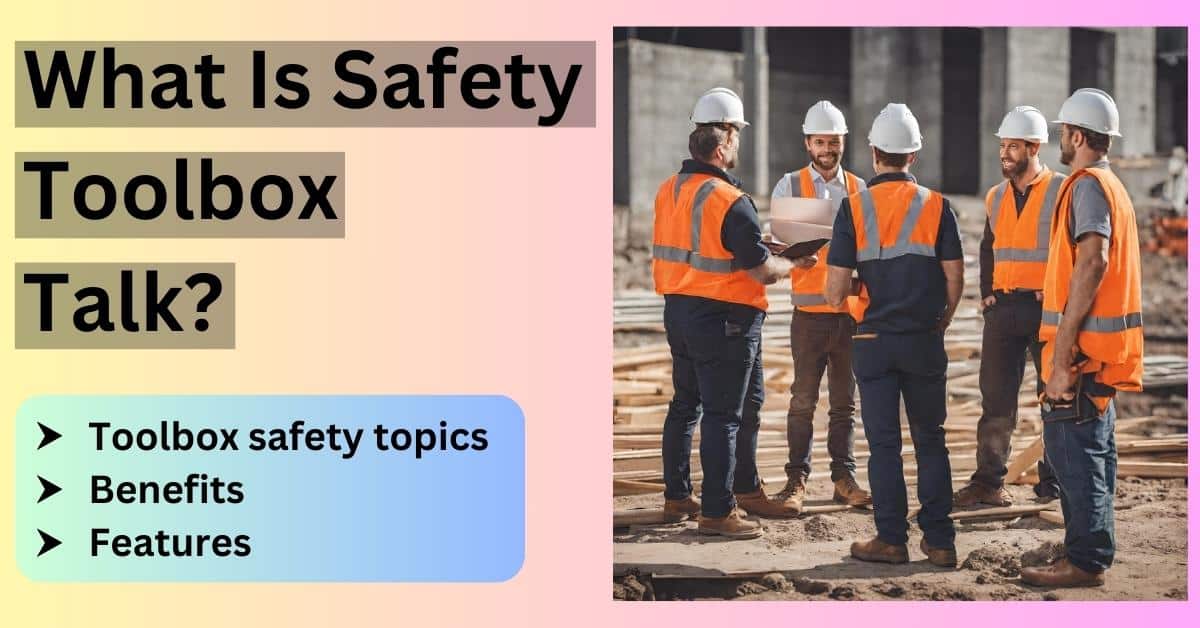
Customize for the Job Don’t just read from a script. If your team is installing HVAC units on a rooftop, tailor the fall protection talk to that specific roof layout, anchor options, and weather conditions.
Engage, Don’t Lecture Ask questions. Use “what would you do?” scenarios. Pause for input. The best talks feel like team huddles, not safety sermons.
Document with Purpose Sign-in sheets are mandatory, but go further. Add a line for “key takeaway” or “one safety tip I’ll use today.” It reinforces accountability.
Review and Refresh Revisit your topics list quarterly. Remove outdated items. Add emerging risks—like drone use near power lines or EV battery handling in maintenance bays.
Common Pitfalls to Avoid
Even experienced supervisors fall into traps that undermine toolbox talks.
- Repetition without variation: Repeating “PPE is important” weekly has zero impact. Change the angle: “Three ways your safety glasses failed last month—and how to fix it.”
- One-size-fits-all delivery: Office staff, welders, and crane operators face different hazards. Segment talks when possible.
- Ignoring near-misses: A dropped tool from height isn’t “just luck.” Make it a talk topic—today.
- Skipping talks during rush periods: High-pressure days are exactly when safety focus is needed most.
- No follow-up: If a talk covers ladder safety, supervisors should reinforce it that day—check ladder angles, ask questions, acknowledge compliance.
Making Toolbox Talks Stick
The goal isn’t to check a box. It’s to change behavior.
One electrical contractor reduced arc flash incidents by 70% over 18 months—not by longer training, but by running targeted 10-minute talks before every high-risk task. They used real photos from near-misses, involved junior staff in leading discussions, and posted summaries on site boards.
Your toolbox talk topics list should evolve like your projects do. Add new equipment risks. Address mental fatigue during long shifts. Talk about how rushing creates invisible hazards.
When workers start asking, “What’s today’s safety talk about?” you’ve built momentum. When they start bringing up issues unprompted, you’ve built culture.
Update your topics list quarterly. Train supervisors to facilitate, not dictate. And never underestimate the power of a five-minute conversation that prevents a lifetime of regret.
Stay sharp. Stay safe. Talk often.
FAQ
How often should toolbox talks be held? Weekly is ideal for active job sites. Daily for high-risk tasks like excavation or working at height.
Who should lead a toolbox talk? Supervisors typically lead, but rotating among team members increases engagement and ownership.
Do toolbox talks need to be documented? Yes. Keep sign-in sheets with topic, date, attendees, and supervisor signature for compliance and tracking.
Can toolbox talks be too short? They should be 10–15 minutes. Shorter loses impact; longer reduces attention. Focus on one clear topic.
Should toolbox talks be the same across all sites? No. Customize based on site hazards, tasks, weather, and crew experience.
What if workers don’t participate? Shift from lecture to dialogue. Ask open-ended questions, use real examples, and recognize input.
Can toolbox talks reduce incident rates? Yes—when relevant and consistent. They reinforce safety behaviors and catch hazards before they cause harm.
FAQ
What should you look for in Toolbox Talk Topics List for Safer Workplaces? Focus on relevance, practical value, and how well the solution matches real user intent.
Is Toolbox Talk Topics List for Safer Workplaces suitable for beginners? That depends on the workflow, but a clear step-by-step approach usually makes it easier to start.
How do you compare options around Toolbox Talk Topics List for Safer Workplaces? Compare features, trust signals, limitations, pricing, and ease of implementation.
What mistakes should you avoid? Avoid generic choices, weak validation, and decisions based only on marketing claims.
What is the next best step? Shortlist the most relevant options, validate them quickly, and refine from real-world results.